


|
|
Autumn
Budget 2025 - what did Rachell Reeves reveal? Today the Chancellor of the Exchequer Rachel Reeves delivered her Autumn Budget Statement to the House of Commons updating MPs on the country's finances and the Government's plans for tax and public spending. Alongside her statement, the Government published an updated assessment of the UK economy from the Office for Budget Responsibility (OBR). That assessment indicated the outlook for the UK economy since the Autumn Budget in October 2024. Extraordinary early release of the OBR Budget Report Less than an hour before the Chancellor was due to make her statement in the House of Commons there was an extraordinary premature release of the OBR report online revealing the contents of the Chancellor's Budget. Chris Mason and Faisal Islam on BBC television were astonished and in effect had the contents of the Budget measures available to them for discussion before the Chancellor had released the details in the House of Commons! - unbelievable utter chaos. Key points in the Autumn Budget statement for classic car enthusiasts Freeze on tax thresholds Both National Insurance (NI) and income tax thresholds will be frozen for an extra three years beyond 2028. Although the tax rates were not increased the threshold freeze will have the effect of more people paying the higher tax rates. It's known as "fiscal drag" so in effect the freeze is a significant "stealth tax" on working people and pensioners where they fall into the 40% tax band and pay more income tax on their earnings or pension income and any investment income. That's a significant loss of income for discretionary spending - including owning, maintaining and driving a classic car like an MGV8. From Autumn Budget 2025 document (page 107) Link 4.109 Income tax Personal Allowance and higher rate thresholds – The Government is maintaining the income tax Personal Allowance at £12,570 and higher rate threshold at £50,270 from April 2028 to April 2031. The additional rate threshold remains at £125,140 from April 2028 to April 2031. The Personal Allowance threshold applies UK-wide. The higher rate threshold for non-savings, dividend and property income and for property income will apply to taxpayers in England, Wales and Northern Ireland, and for savings and dividend income it will apply UK-wide. This will be legislated for in Finance Bill 2025-26. 4.110 Inheritance tax thresholds – The inheritance tax nil-rate bands are already set at current levels until April 2030 and will stay fixed at these levels for a further year until April 2031. The forthcoming combined allowance for the 100% rate of agricultural property relief and business property relief will also be fixed at £1 million for a further year until 5th April 2031. This will be legislated for in Finance Bill 2025-26 and take effect from 6th April 2030. Fuel duty freeze extended The 5p cut in fuel duty has been extended until September 2026. The saving will be around £40 pa for a typical driver but the freeze avoids the cost generating an inflationary factor in the economy for trades vehicles where businesses would pass on those costs to consumers. From Autumn Budget 2025 document (page 96) Link 4.4 Fuel duty: 2026-27 main rates – The Government will extend the temporary 5p fuel duty cut for a further five months, with the cut being reversed in three stages: 1p on 1st September 2026, 2p on 1st December 2026 and 2p on 1st March 2027. This will return rates to pre-March 2022 levels. The planned inflation increase for 2026-27 will not take place, with the Government uprating fuel duty rates by Retail Prices Index (RPI) from April 2027. See charts showing how the fuel duty rates could change over the next couple of years. Link "Mansion tax" charges Properties worth more than £2m will be charged £2,500 annually from 2028. That charge will be paid from taxpayers' income after income tax has been deducted, so it will be a significant loss of income for discretionary spending for working people and those in retirement including spending on owning, maintaining and driving a classic car. The delay to 2028 is to provide time for valuing the higher band properties to determine which are subject to the "mansion tax". Rachel Reeves says this charge will be levied on property owners and collected alongside local council tax. From Autumn Budget 2025 document (page 36) Link 2.41 At the Budget, the Government is asking those owning the highest-value properties to contribute more. The government is introducing a High Value Council Tax Surcharge (HVCTS) in England for residential properties worth £2 million or more, from April 2028. This charge will be based on updated valuations to identify properties above the threshold and will be in addition to existing Council Tax. Fewer than 1% of properties will be in scope of HVCTS.112 New charges start at £2,500 per year, rising to £7,500 per year for properties valued above £5 million, and will be levied on property owners rather than occupiers. Local authorities will collect this revenue on behalf of central government and will be fully compensated for the additional costs of administering this new tax. Revenue will be used to support funding for local services, with further consideration through the next spending review in 2027. The Government will consult on detailed implementation of the HVCTS in the new year, including to determine who might need additional support to pay the charge and how to deliver it. New excise duty for electric cars The Chancellor announced a new electric vehicle excise duty saying "this will be payable each year alongside vehicle excise duty (VED) at 3p per mile for electric cars and 1.5p for plug-in hybrids. She added this will enable the Government to double road maintenance funding in England, and offer a further £200m for a rollout of electric vehicle charging points. In recent weeks the Government has said it wanted a "fairer system for all drivers", pointing out fuel duty covered petrol and diesel but there was no equivalent for electric vehicles. From Autumn Budget 2025 document (page 120) Link 4.233 Electric Vehicle Excise Duty (eVED) – The Government is introducing Electric Vehicle Excise Duty (eVED), a new mileage charge for electric and plug-in hybrid cars, with effect from April 2028. Drivers will pay for their mileage on a per-mile basis alongside their existing Vehicle Excise Duty. Electric cars will pay half the equivalent fuel duty rate for petrol and diesel cars, and plug-in hybrid cars will pay a reduced rate equivalent to half of the electric car rate. The Government has published a consultation which provides further detail on how eVED will work and seeks views on its implementation. The consultation will remain open until 18th March 2026. Vehicle Excise Duty (VED) rates increase The VED rates for cars will increase in line with RPI from 1st April 2026. Currently the VED rate for a car (over 1549cc like an MG RV8) registered before 1st March 2001 is £360. The RPI rate now is around 4.3%so that would take the annual VED rate for an MG RV8 to £373. Link From Autumn Budget 2025 document (page 121) Link 4.240 Vehicle Excise Duty for cars, vans and motorcycles – The Government will uprate Vehicle Excise Duty rates for cars, vans and motorcycles in line with RPI from 1st April 2026. 4.242 Vehicle Excise Duty (VED) – Expensive Car Supplement (ECS) – The Government will increase the Vehicle Excise Duty Expensive Car Supplement threshold to £50,000 for zero-emission vehicles only. This change will take effect from 1st April 2026 and will apply to ZEVs registered from 1st April 2025 onwards. Historic vehicles VED exemption remains Chris Armitage noted "it's a relief that free road tax remains for our Historic vehicles. Many people on various forums were concerned that it would be withdrawn (or maybe frozen at a particular point). I took the precaution of changing the tax classification of a couple of my long term 'SORNd' vehicles to the Historic tax class in case that option was about to be withdrawn. With five classic cars (including the V8 of course) it could have made quite an impact, and potentially reduced the market value of our cars a little". Government borrowing costs fall after Budget measures confirmed Michael Race BBC Business and economics reporter "We've been closely watching how the UK bond markets have been reacting to the Budget this afternoon - in short it appears they are largely happy with the Chancellor's choices as the policy measures are digested, with the cost of Government borrowing falling. The yield - the effective interest rate - on Government borrowing over 10 years has fallen to 4.41%. It whipsawed following the early leak of the OBR's economic forecast, hitting a high of 4.52%, but has been trending downwards. Governments sell bonds - essentially IOUs - to raise money for public spending and in return they pay interest. Shortly after the Budget, the Debt Management Office said planned bond sales were being increased - meaning the Government is borrowing more money". Link to BBC News item Front pages on Thursday 27th November 2025 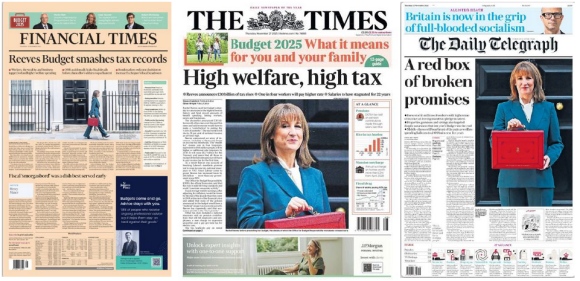 See Press headlines the following morning . . . . . . posted 251127 |
 |
During
the three months before the Autumn Budget 2025 See report on the Spring Budget 2025. Link Comment: an increase in fuel duty would create a compounding inflationary effect in the UK economybecause the expense of motor fuels for private and business drivers is a key part of the cost of living. Those increases in fuel costs for the distribution and delivery of goods and and other road transport costs are inevitably passed on to the end users and consumers together with VAT on those costs. With congestion charges now payable by drivers for access to major urban areas the combination of those charges and higher motor fuel costs will encourage drivers of all vehicles to look for ways of reducing daily use. For private car users that could mean considering using public transport more often to reduce the fuel cost increases and congestion charge payments. Despite her fiscal rules and with limited options for balancing her Budget, the option of ending the fuel duty freeze has to be on the Chancellor's list of tax options to be announced in November 2025! Vehicle road tax changes coming? Ahead of the Autumn Budget, set for Wednesday 26th November 2025, one possible tax option the Chancellor may have on her list is higher road tax rates on large and heavy cars like SUVs and EVs. Link |
| Looking
back to the Spring Budget 2025
See our report on the Spring Budget 2025 report. More Spring Statement 2025 on 26th March 2025 started at 12.30pm after Prime Minister's Questions and ran for an hour. As usual we have a prompt report on what the Chancellor had to say shortly after she finished her statement to MPs. The Treasury message seems to be "the Spring Statement is not a Budget but is a continuation of the Chancellor’s existing strategy. There will be no tax changes, instead only a small table of new policies, meant to correct a gap in the public finances". Spring Statement 2025 document Posted: 250326 HM Treasury press release Link OBR economic and fiscal outlook published. Timetable & OBR Forecast See our earlier report on fuel duty See our earlier article on UK road tax |
Spring
statement 2025 - what did we see of interest to classic car enthusiasts? Fuel duty freeze until 2025-2026 The temporary 5p cut in fuel duty rates extended by 12 months in the Autumn Budget 2024 will remain and will expire on 22nd March 2026. The planned inflation increase for 2025-26 will also not take place. The freeze is a tax cut worth £3 billion over 2025-26 which represents a £59 saving for the average car driver. See NEWS update below Increase in NICs announced in the Autumn Budget 2024 The additional cost of the NICs increase for businesses providing specialist maintenance, restoration and replacement parts services, will be passed on to purchasers in whole or part increasing the costs of those services for classic car owners. 2025-26 Vehicle Excise Duty rates for cars, vans & motorcycles The Government will uprate standard Vehicle Excise Duty (VED) rates for cars, vans and motorcycles, excluding first year rates for cars, in line with the RPI from 1st April 2025. There was no mention of any adjustments to the current VED exemption arrangement for historic vehicles over 40 years old. Potholes The financial settlement for the transport sector in the Autumn Budget 2024 provides increased investment in local roads maintenance. It does this by "going beyond the Government’s promise to fix an additional 1 million potholes per year and providing a £500 million cash increase on 2024-25 local roads maintenance baseline funding". No adjustment to the settlement was announced by the Chancellor. Alcohol duty The UK Government will support pubs and the wider on-trade by cutting alcohol duty rates on draught products below 8.5% alcohol by volume (ABV) by 1.7%, so that an average ABV strength pint will pay 1p less in duty. The Government will also increase the discount provided to small producers for non-draught products, and maintain the cash discount provided to small producers for draught products, increasing the relative value of Small Producer Relief. Alcohol duty rates on non-draught alcoholic products will increase in line with RPI inflation. These measures will take effect from 1st February 2025. The current temporary wine easement will also end as planned on 1st February 2025. So a pint of real ale should have 1p less in duty at your local pub. Other topics VED on Electric Vehicles from April 2025 With the UK Government's ban on the sale of new petrol and diesel vehicles from 2030 the reform of motor taxes had become an urgent question for the Treasury because the switch to electric cars means almost £30bn in fuel duty raised annually for the Treasury will need to be replaced. VED will be paid by electric vehicles from April 2025. Updates with additional news seen on the Spring Statement and the OBR economic and fiscal outlook BBC comment mentioning fuel duty A post on the BBC News thread about 15 minutes after the Chancellor had sat down reports comments from an OBR forecaster on the "tax share to hitting a postwar high". Posted 250326 @ 14.13 The BBC thread: "The UK's tax share - which means how much HMRC brings in compared to the size of the overall economy - is forecast to hit its highest level since the end of World War Two, the Office for Budget Responsibility (OBR) predicts. In its report, the OBR forecaster reckons it will reach 37.7% of the economy by 2027/28. This is partly because of the increase in employers' National Insurance contributions which the Government announced in October's Budget. However that figure is highly speculative. In totting up its calculations for the future, the OBR assumes that the Government will implement a 5p rise on fuel duty - something previous governments have been loath to do". BBC News thread |
|
|||


