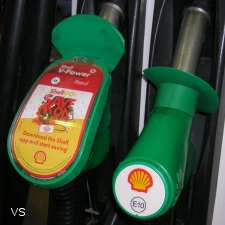
FBHVC hopeful E5 will continue to be available
The availability of E5 fuel is due to be reviewed by the UK Government
in 2026. So E5 is safe for now but it’s not a certainty looking
ahead. That’s why understanding E10 - rather than avoiding it
entirely - is worth the effort. This
is very much the case as the possible cut-off point for
the availability of E5 could be in September 2026.
Biofuel concerns with classic MGs
See our Index to articles that are available on the V8 website on
these biofuel & E5 topics. Link
Continued availability of E5 fuel is essential for
historic & classic vehicles
Note on a comment from the FBHVC that the UK Government intends consulting
on retaining E5 motor fuels in 2026. Link
Replacing rubber fuel hose with Gates Barricade hose
Link
Posted: 260130 |
FBHVC
update regarding the transition to E10 fuel in the UK
An
update from the FBHVC at the Club Expo event mentioned that
with the introduction of E10 petrol back in September 2021 the
UK Government at the time said "E5 fuel would be available
for the next 5 years". The availability of E5 fuel
is due to be reviewed by the UK Government in 2026 so the cutoff
point for
the availability of E5 could be in September 2026. So E5 is
safe for now but it’s not a certainty looking ahead. That’s
why understanding E10 - rather than avoiding it entirely - is
worth the effort.
E5 availability concerns: When E10 petrol became the
standard fuel in September 2021, E5 was designated as the "protection
grade" to protect older engines that are not compatible
with E10. E5 is known as "premium/super unleaded 97+ octane
petrol". With up to 5% ethanol E5 is still available as
the "super" grade, but it is more expensive
and not guaranteed to be stocked at all smaller, rural and smaller
fuel stations long-term.
|
E10
and E5 petrol
The change to E10 fuel was driven by environmental goals: increasing
ethanol content helps reduce CO2 emissions from petrol vehicles
by up to 750,000 tonnes per year, which is equivalent to taking
350,000 cars off the road. But while modern engines and fuel
supply systems are designed to handle higher ethanol in fuels
without difficulties, for many classic cars the higher ethanol
content can cause problems.
Ethanol is hygroscopic, which means it absorbs water from the
atmosphere which can cause condensation to form in the fuel
system, which in turn causes corrosion - especially in older
components like carburettors and fuel tanks - and damage
to rubber fuel hoses. Also ethanol acts as a solvent which
can dissolve old varnishes and deposits inside fuel systems.
In older engines in classic cars that can clog fuel lines, filters
and carburettors, causing poor running and breakdowns. |
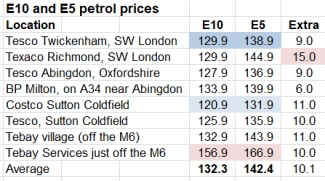
Prices
of E10 and E5 petrol
Looking at the prices of E10 and E5 on the petrolprices.com
website in four locations around England today: |

|
 |
E10
concerns classic car owners
Perished
rubber fuel lines and seals
Ethanol can degrade rubber and plastic components that are not
made to cope with it. See
our note on checking the condition of your fuel hoses.
Link
Blocked
fuel jets and filters
Ethanol's solvent properties can dislodge gunk that’s been
stable in fuel systems for years.
Poor starting
and running
Ethanol affects air/fuel mixtures and volatility, which can
disrupt performance in carburetted engines.
According to the Federation of British Historic Vehicle Clubs
(FBHVC), around 600,000 vehicles on UK roads are not compatible
with E10 - a large proportion of which are classic cars like
MGV8s. Fortunately E5 petrol hasn’t disappeared, yet. With
E10 now the standard ‘Premium’ (95 RON) petrol, E5
remains available as the higher-octane ‘Super Unleaded’
(97+ RON) at most forecourts. |
|


