


 As usual we have a prompt report on what the Chancellor had to say in her Spring Forecast statement on Tuesday 3rd March 2026 which highlights the key points of interest for MGV8 enthusiasts. Spring Forecast 2026 GOV.UK website Posted: 260303 @ 13.20 Autumn Budget 2025 - what did Rachel Reeves reveal? See our review. Link  Leaks? - a leak reported in the Business section of the Daily Telegraph noted a Treasury source said "We want this (the Spring Forecast) to be a complete non-event. The goal is to be as boring as possible in the hope it will be seen as a sign of stability". See a guide to budget statement buzzwords. More... What did we expect in the Spring Forecast 2026? See views of Bishop Fleming. Link See guide from Alexander & Co. Link |
Spring
Forecast 2026
- what did Rachel Reeves reveal The
OBR report include the clarification: "The Government set out
in the November 2025 Budget Statement that it would legislate so
that the OBR only assesses performance against fiscal rules once
a year at Budgets, while the OBR would continue to publish a second
annual five-year forecast each spring. This EFO therefore does not
include an assessment of performance against the fiscal rules. In
terms of the legislation underpinning this change, the Charter for
Budget Responsibility: Autumn 2025 was passed into law on 24 February
2026. This update to the Charter removes the requirement that OBR
forecasts be accompanied by assessments of “the extent to which
fiscal policy has delivered, or is likely to deliver, the fiscal
mandate”, removing the requirement for this EFO to include
such an assessment. In producing this EFO without an assessment
of performance against the fiscal rules, we are also acting on the
reasonable assumption that the law will have changed by the end
of the financial year to require us to only produce one assessment
a year, as the Government proposes in the Finance Bill 2025-26". |
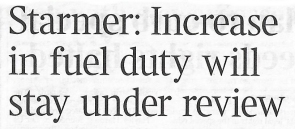 Headline in a News item in The Times Posted: 260312 |
Increase
in fuel duty to be reviewed In the Autumn Budget 2025 the Chancellor announced that the 5p per litre temporary cut in fuel duty (or 6p including VAT) introduced in 2022 will be reversed, with a 1p increase in September 2026, 2p in December 2026, and a further 2p in March 2027. The current fuel duty is 52.95 pence per litre plus VAT, so a total of 63.54 pence or 9.4% of the current average price of petrol in the UK of 140.5 ppl. Sir Keir Starmer has said the Government is reviewing its plans to increase fuel duty in September 2026 because of the Iran war. The decision follows pressure from opposition political parties in Parliament and concerns about rising costs of living in the UK. Fuel prices in the UK The average price for unleaded at the pumps has increased 5.3ppl in March 2026 while diesel is up by 9.4ppl. So although pump prices have increased quickly, wholesale prices have moved much faster. There is therefore a high chance that we may see further price increases at the pumps even if headline Brent prices started to fall. What will be noticeable is a wider range of prices. When volatility increase so does the range of prices across petrol stations. So, shopping around really does help you save money on fuel. Fuel prices vary between filling stations run by supermarkets and those by premium brand fuel companies Supermarket petrol has averaged around 137.7p per litre while premium brands (BP, Shell, Esso) have seen averages around 141.8p. Experts suggest that average petrol prices could continue to climb towards 140p or 150p per litre if the situation in the Middle East escalates with consequent wider economic disruption. |
|
|||


