Understanding
the markings on the sidewalls of tyres will help you to choose the
right tyres for your car. Here's a guide to those sidewall markings
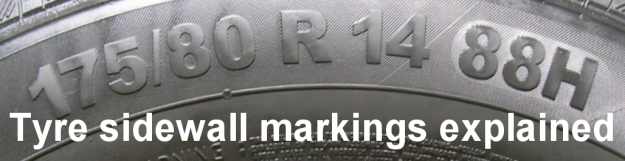
using a 175/80 R14 88H tyre as an example: 175 - Tyre width across the tread measured in mm. 80 - Aspect ratio or profile height of the tyre calculated as the sidewall height expressed as a percentage of the tyre width. So a tyre with an aspect ratio of 80 is a tyre whose height is equal to 80% of its width. Modern tyres have lower aspect ratios - for example 60 - than the 80 originally fitted to the MGBGTV8. The expressions "tyre width" and "sidewall height" used above are more accurately defined as: Section width - the width of the inflated tyre section, excluding any lettering or decoration on the sidewall. Section height - the radial distance between where the bead of the tyre sits on the wheel rim to the outer most point at the centerline of the tread. Selecting a lower aspect ratio than originally specified for the wheel on your classic MG can lower the gearing, so care needs to be taken in any tyre choice. However if your fit wider tyres, say 195 rather than 175, then a slightly reduced aspect ratio may not result in a significant change to the gearing of the drive train but it will need careful thought before making a decision on choice of tyre width and aspect ratio. If in doubt seek advice from a specialist tyre supplier or fitter. See the note on Changing either wheel size and/or tyre width and aspect ratio below and also V8NOTE187 for more information. R - Radial construction. This marking is almost redundant these days because very nearly all tyres for cars are radials but when the MGBGTV8 was launched in 1973 tyres with crossply construction were still available and fitted to some vehicles. Radial tyres were specified equipment for the MGBGTV8 from its launch. 14 - Wheel rim diameter. This is the diameter in inches of the rim of the wheel that the tyre has been designed to fit. 88 - Load index is a numerical code which gives the maximum load that the tyre can carry whilst it is travelling at up to the maximum speed set by the speed rating of the tyre. In the example above, 88 means that this tyre can carry 560 kg whilst travelling at its maximum speed. See the table below for the various load index codes and the corresponding maximum loads. H - Speed rating indicates the maximum permitted speed that the tyre can endure for a period of ten minutes without being in danger of sustaining damage. The speed rating of the tyre must match or exceed the maximum speed of your car. See the table below for the maximum permitted speeds for each speed rating. Generally tyre speed ratings are in alphabetical order, however W and Y rated tyres are a special case as they can operate at higher maximum speeds than older Z rated tyres. It is therefore safe to replace your current Z rated tyres with W or Y rated tyres. Important note regarding load index and speed rating. It is essential you do not fit tyres to your vehicle with a lower speed rating or load index than recommended by the vehicle manufacturer. Fitting lower speed rated tyres or tyres with a lower load index may invalidate your insurance. Although the UK speed limit is just 70mph, most vehicles are more than capable of exceeding this speed. Therefore vehicle insurance companies will insist that the tyres of the correct speed rating are fitted to your vehicle. E4 DOT. The E4 marking is an ECE type approval mark which demonstrates the tyre has been tested as high quality by the European Regulatory Authorities. All tyres for use in the USA have the DOT code as required by the US Department of Transport (DOT). It specifies the company, factory, mold, batch, and date of production - 2 digits for the week of the year plus 2 digits for the year; or 2 digits for the week of the year plus 1 digit for the year for tyres made prior to 2000. So in the example below the 0508 indicates that tyre was made in May 2008.  Additional information on the sidewall will include the manufacturer's name and the country of origin. Earlier sidewall markings. Prior to 1991, tyre speed ratings were shown between the tyre size and the "R" character in the case of a radial construction tyre. For example in the MGBGTV8 Driver's Handbook AKD 8423 page 67 the recommended tyres were 175HR x 14 radial ply. The available codes were SR (112 mph, 180 km/h), HR (130 mph, 210 km/h), VR (in excess of 130 mph, 210 km/h) and ZR (in excess of 149 mph, 240 km/h). The ZR code is still in common use, often combined with a W or Y speed code. Changing either wheel size and/or tyre width and aspect ratio When considering changing either wheel or tyre sizes, it is necessary to retain an overall diameter (wheel rim diameter plus the tyre sections) which is as close as possible to the original so that the gearing of the drive train is not adversely altered. Changing the overall diameter will also alter the ride height. There is a very useful Tyre Size Change Calculator on the etyres website which can help you. http://www.etyres.co.uk/tyre-size-calculator.htm 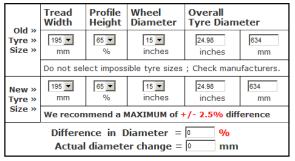 Replacement tyres for the MGBGTV8 model The original tyre specified in MGBGTV8 Driver's Handbook AKD 8423 was 175HR x 14 radial ply.The current replacement tyre to maintain the key original features of the model - the original appearance of the wheel in the wheel arches and drive train gearing - is a 175/80 R14 88H. Enthusiasts preferring what they feel might be uprated handling with other wheel size and/or tyre width and aspect ratio combinations will need to use the Tyre Size Change Calculator above to check the net effect on drive train gearing, refer to the useful information in V8NOTE187 and seek advice from a reputable tyre specialist with experience of modern tyres for a classic sportscar like the MGBGTV8. Replacement tyres for the MG RV8 model The original tyre specified in MG RV8 Owner's Handbook AKM 7144ENG was 205/65 ZR 15.The current replacement tyre to maintain the key original features of the model - the original appearance of the wheel in the wheel arches and drive train gearing - is a 205 65 R15 V. Enthusiasts preferring what they feel might be uprated handling with other wheel size and/or tyre width and aspect ratio combinations will need to use the Tyre Size Change Calculator above to check the net effect on drive train gearing, refer to the useful information in V8NOTE187 and seek advice from a reputable tyre specialist with experience of modern tyres for a classic sportscar like the MG RV8. Weights - chrome bumper MGBGTV8 MGBGTV8 Driver's Handbook AKD 8423 (4th Edition) page 68 Weights - rubber bumper MGBGTV8 MGBGTV8 Driver's Handbook AKD 8423 (4th Edition) page 81 Weights - MG RV8 MG RV8 Owner's Handbook AKM 7144ENG page121 Technical Data MGBGTV8 - tyre pressures and wheel nut torque settings MGBGTV8 Driver's Handbook AKD 8423 (4th Edition) page 68 Road wheel nut torque 81 Nm or 60 lbf ft Remember to centre the holes in the alloy wheel centre over the studs using a pair of slave MGB wheel nuts because the V8 wheel nuts are sleeved. MG RV8 - tyre pressures and wheel nut torque settings MG RV8 Owner's Handbook AKM 7144ENG page120 Technical Data |
|
|
V8
Register - MG Car Club - the leading group for MG V8 enthusiasts
at www.v8register.net
|
|