Bystander
CPR
Your action could help save
a life
In a recent email from Thames Valley Air Ambulance they highlighted
a situation anyone could meet:
Someone has collapsed in front of you clutching their chest.
As you race to help, you discover the person isn’t breathing.
You dial 999 and the operator instructs you to perform lifesaving
CPR. You put you phone down alongside the casualty with the speaker
on so you can hear the instructions.
Possibly a
defibrillator is brought from nearby. As the device is switched on,
it instructs you to remove the person’s clothing and apply defibrillator
pads to their bare chest. Now,
ask yourself honestly. If this was a woman, would you do anything
differently?
Thames Valley
Air Ambulance add "We’re not trying to catch you out. We’re
trying to direct your attention to an uncomfortable reality. Women
are less likely to receive bystander CPR. In
fact, one in three female cardiac arrest patients receive no CPR until
ambulance crews arrive on scene". TVAA
add "We’re releasing this CPR data following International
Women’s Day, to urge more people to step forward if they witness
a woman in cardiac arrest".
See their graphic guides to CPR and AED Defib support via the links
alongside.
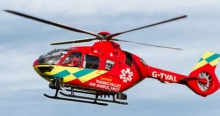
Make a donation to support Thames Valley Air Ambulance.
Link
Thames Valley Air Ambulance Mission Map of call outs.
Link
Posted: 260312 |
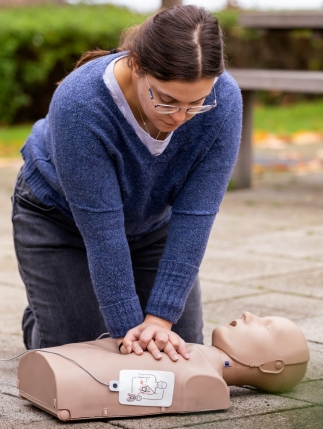
How
to perform hands-only CPR
When someone suffers a cardiac arrest and their heart
stops beating normally, every minute matters.
Step One: Call for help
If you find someone collapsed, make sure it’s safe to approach.
If they are unresponsive or not breathing normally, call 999
immediately and ask for an ambulance.
Step Two: Start CPR
Use the hands-free speaker on your phone, so that you can start
CPR whilst speaking to ambulance control. If someone else is
nearby, ask them to find and bring a defibrillator if one is
available.
Step Three: Interlock your fingers
Kneel next to the casualty and place your hand in the centre
of their chest. Place the palm of your other hand on top of
the first hand and interlock your fingers. Keep your arms straight
and lean over the casualty.
Step Four: Give chest compressions
Push down hard then release fully twice per second. Don’t
stop. Do this at a rate of 100 – 120 times a minute.
Step Five: Continue CPR
Continue to perform CPR until emergency help arrives and takes
over, a defibrillator is ready to be used, or the person starts
showing signs of life and begins to breathe normally.
See Thames Valley Air Ambulance CPR
guide Link
"Doing something is better than
nothing. Without CPR or defibrillation, a person in cardiac
arrest will not survive."
Tracey, Critical Care Paramedic |
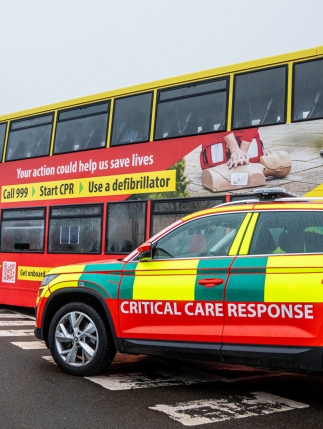
How
to use an AED (Defibrillator)
An AED (Automated External Defibrillator) is a small, portable
device that can save someone whose heart has stopped. It works
by delivering a controlled electric shock to help the heart
start beating normally again. AEDs are designed for anyone to
use, even without training, and they guide you step by step.
Step One: Turn on the AED
Switch the device on and follow the spoken instructions. The
AED will guide you through each step.
Step TWO: Expose and prepare the chest
Cut or remove clothing so that pads can stick to bare skin.
This includes any bras if necessary. If the chest is wet, wipe
it dry. Some AED packs include a small razor, use it to shave
any chest hair where the pads will be applied – this will
help them stick properly and work effectively.
Step Three: Attach the pads
Place the pads exactly where the pictures on the AED show. One
pad usually goes on the upper right chest, and other on the
lower left side.
Step Four: Stand clear
The AED will analyse the heart rhythm and tell you if a shock
is needed. Make sure no one is touching the person when the
shock is delivered.
Step Five: Continue CPR
After a shock, or if no shock is advised, continue CPR as instructed
by the AED until the ambulance arrives or the person shows signs
of life. You
can give someone the best chance of survival, simply by following
instructions from the AED. Don’t be afraid to take action.
Without CPR and defibrillation, a person in cardiac arrest will
die.
See Thames Valley Air Ambulance AED
Defib guide Link
|
|


