Beware
of potholes
Last year saw a 15% increase in the number of drivers suffering
pothole-related breakdowns, new RAC Pothole Index data shows.
An article on the RAC website reports their "expert patrols
attended a total of 26,048 breakdowns in 2025 - the equivalent
of 71 every day - where damaged shock absorbers, broken suspension
springs or distorted wheels were the cause, up 3,345 from the
22,703 logged in the previous year". RAC
article
Louise
Parry in a piece on the BBC News website says "I was driving
on the B653 - a well-used cross-country road that connects Luton
to the A1(M) near Welwyn Garden City in Hertfordshire - when
a pothole loomed in front of me. The road was too narrow to
swerve and avoid the pothole and I heard a nasty clunk. I put
on the hazard lights - as did the driver in front, and the two
vehicles behind. There were four cars with busted tyres, thanks
to a pothole!" Link
What
is behind the spike in pothole related incidents?
Potholes are formed by a damaging circular process. Tiny cracks
develop in the road surface, usually caused by traffic, particularly
heavy vehicles, that allow water to seep into the road surface
and often further down into the substructure. When that freezes,
it expands as ice and makes the cracks bigger. Further traffic
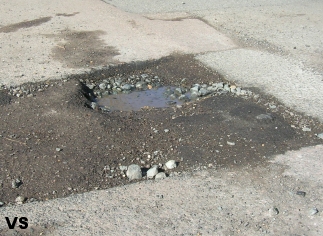
can turn that crack into a hole as in the example in the photo
above. For 2026 Met Office data shows most counties in the
East and Southwest of England, have already had above-average
rainfall this Winter.
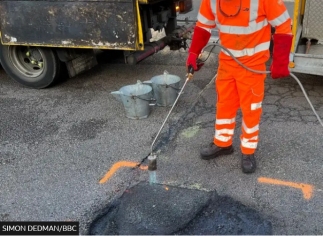
Local councils use the emergency repairs procedure usually
with cold-mix asphalt, which can be used in cold or wet conditions.
Usually it lasts two to three months but by then hopefully
the council will schedule longer-lasting repairs in Spring
for a repair using a hot-mix asphalt. The only solution is
to completely resurface the road making roads more resistant
to surface damage but many councils have had severely curtailed
budgets, particularly in recent years. The Department for
Transport have said: historic under-investment has made it
difficult for local authorities to maintain their roads, and
the average driver forks out nearly £320 to repair serious
pothole damage.
What
damage can cars suffer from potholes?
Potholes can damage tyres and also cause damage to shock absorbers
and suspension springs and can also distort wheels. Classic
cars are particularly at risk so keeping a keen eye on the
road ahead is vital so you can move to avoid an ugly pothole.
But swerving to miss a pothole on narrow roads is not always
possible.
Pothole damage repair bills can be costly - the RAC estimates
that a typical repair bill for a family car with damage worse
than a puncture from a pothole is £590. RAC analysis
of claims data has indicated that 53,015 compensation claims
were made to 177 local authorities in 2024 with just 26% of
claims resulting in a payout, with an average sum of £390
given to claimants.
|