"Carspreading'
is on the rise - sometimes called "autobesity"
In
an online BBC INDEPTH article by Theo Leggett (BBC
International Business Correspondent) on the BBC News website he says
"Critics call it "carspreading". In the UK and across
Europe, cars are steadily becoming longer, wider and heavier. Consumers
clearly like them – a lot. Big cars are seen as practical, safe
and stylish, and sales are growing. So, why are some cities determined
to clamp down on them - and are they right to do so?"
Link to BBC News item
He adds "There is no question cars in the UK and Europe have
been getting bigger over the years. Since 2018, the average width
of new models on sale in the UK has risen from 182cm to 187.5cm, according
to data from Thatcham Research – an organisation that evaluates
new cars on behalf of the insurance industry. The average weight,
meanwhile, has increased from 1,365kg to 1,592kg over the same period.
It's not just a recent phenomenon. Data compiled by the International
Council for Clean Transportation shows the average width of cars on
European markets grew by nearly 10cm between 2001 and 2020. Length
increased by more than 19cm. Some critics argue this is a worrying
trend, because there simply isn't enough room on Britain's crowded,
often narrow roads or in town centres".
Posted: 251205 |
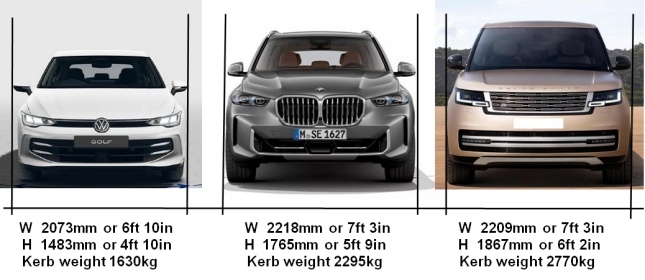
| Comparing
a VW Golf with a BMW X5 and a Range Rover |
|
|
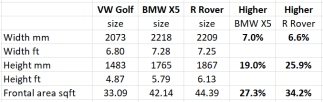
Comparing
width & height
See larger
copies of the data tables. More
Width
including the mirrors
Both are near 5.75 inches or 7% wider than a VW Golf.
Height
A BMW X5 is 19.0% higher than the VW Golf and a Range
Rover 25.9% higher.
Frontal Area
A BMW X5 is 27.3% larger than the VW Golf and a Range
Rover is 34.2% larger. These increases are significant
because the larger frontal size of an SUV or 4x4 vehicle approaching
you on a relatively narrow urban street or on a narrow country
lanes can be daunting and in some cases makes passing
difficult. |
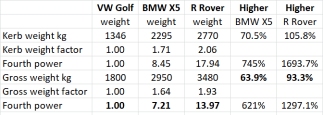
Comparing
weight
Fourth
power law (also known as the fourth power rule)
It's a rule of thumb which states that the stress on the road
surface and structure caused by a motor vehicle increases in
proportion to the fourth power of its axle load. This law was
discovered in the course of a series of scientific experiments
in the United States in the late 1950s and was decisive for
the development of standard construction methods in road construction.
Link
& Link
Looking at the comparative weights and the analysis above you
can see how the fourth power numbers are significantly higher
with heavier cars. A BMW X5 is 7.21 and the Range Rover
13.97 higher than a VW Golf. |
|
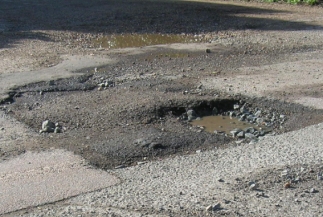 |
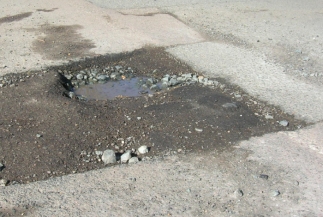
Potholes
are everywhere
Heavier vehicles
create more damage to the road surface and substructure together
with higher traffic flows. |
|